P2D Model Study Notes · Part 3: Butler-Volmer Kinetics
Date: 2026-05-26
Task: Understand and implement the SPM Butler-Volmer equation (electrochemical reaction kinetics)
Progress: BV kinetics · physical intuition + mathematical derivation + code implementation ✓
Learning method: Guided Q&A (question → self-think → hand-derive → reveal answer)
Learning Method
This chapter uses guided learning: each knowledge point starts with a question, allows you to derive yourself, then confirms the answer. When stuck, pause and break it down. All figures generated with matplotlib as PNG.
This chapter is split into three sub-sessions:
| Session | Topic | Core Activity | Output |
|---|---|---|---|
| 3.1 | Physical Intuition | Q&A: overpotential concept → BV forward equation → j₀ dependence → parameter effects | linear_approximation.png |
| 3.2 | Mathematical Derivation | Hand-derive arcsinh inversion → linear approximation → Newton iteration | newton_bv_iteration.png |
| 3.3 | Code Implementation | Build BV function from scratch → visualize → compare with model.py | bv_my.py + bv_overpotential.png |
BV Equation in the SPM Pipeline
1 | Current i_app |
Diffusion (Chapter 2) answers “how lithium distributes inside the particle”, BV (this chapter) answers “how difficult the surface reaction is”. Together → compute overpotential → voltage deviates from ideal OCV.
Session 3.1: Physical Intuition — From “Customs” to the BV Equation
3.1.1 Why Does Overpotential Exist?
Lithium ions entering a graphite particle from the electrolyte is a charge transfer reaction:
$$\text{Li}^+{\text{(electrolyte)}} + e^-{\text{(anode)}} \rightleftharpoons \text{Li}_{\text{(graphite)}}$$
This reaction is not just “drift across and done”. It requires:
- Desolvation: Li⁺ in the electrolyte is wrapped in solvent molecules; it must first shed its solvent shell
- Crossing the interface energy barrier: Bare Li⁺ crosses the electrolyte/solid interface — this is the core step described by the BV equation
- Receiving an electron: Li⁺ + e⁻ → Li (reduction)
| Analogy | Customs |
|---|---|
| Has a visa (OCV says entry is allowed) | Thermodynamic driving force exists |
| Customs queue | Interface energy barrier = kinetic resistance |
| Time spent in queue | Overpotential η |
Key insight: Higher barrier → harder reaction → same current needs larger η. The BV equation describes this “extra push”.
3.1.2 Equilibrium — Dynamic Balance
At equilibrium (η=0):
1 | Forward reaction v_fwd |
Key insight: At η=0, both directions react at high speed microscopically (j₀ measures “how busy microscopically”), just at equal rates. Larger j₀ → a small voltage produces large net current → good battery.
3.1.3 Sign Convention of Overpotential
| Electrode | Reaction during discharge | η sign | Meaning |
|---|---|---|---|
| Anode | Deintercalation (oxidation) | η_n > 0 | Oxidation overpotential |
| Cathode | Intercalation (reduction) | η_p < 0 | Reduction overpotential |
Voltage formula verification (Chapter 4 preview):
$$V_{cell} = U_p + \eta_p - U_n - \eta_n = OCV - |\eta_p| - |\eta_n|$$
Overpotential is a “deduction” — discharge voltage is always lower than ideal OCV.
3.1.4 Exchange Current Density j₀
At α=0.5:
$$j_0 = k \cdot \sqrt{c_e} \cdot \sqrt{c_s} \cdot \sqrt{c_{\mathrm{max}} - c_s}$$
| Factor | Physical Meaning | Intuition |
|---|---|---|
| k | Reaction rate constant | “Entry barrier” height |
| √c_e | Electrolyte lithium concentration | “Supply” side |
| √c_s | Surface solid-phase concentration | “How much lithium can leave” |
| √(c_max−c_s) | Available vacancies | “How many slots can accept” |
Key insight: j₀ ∝ √x·√(1−x) (x=SOC), maximum at SOC=50%. At SOC=0, no lithium to deintercalate; at SOC=100%, no vacancies to accept — j₀ approaches 0 at both ends.
3.1.5 Effect of k on Battery Performance
k↑10× → j₀↑10× → j/(2j₀)↓10× → arcsinh(smaller number) → η↓.
| Parameter | Impact chain | Conclusion |
|---|---|---|
| k↑ | → j₀↑ → η↓ → internal resistance↓ | Goal of materials science: find materials with large k |
3.1.6 Key Parameter Quick Reference
| Parameter | Value | Meaning |
|---|---|---|
| k_n, k_p | 2.0×10⁻¹¹ | Reaction rate constants |
| c_e | 1000 mol/m³ | Electrolyte concentration (constant in SPM) |
| alpha | 0.5 | Symmetry factor |
| c_s_max_n | 31507 mol/m³ | Anode maximum concentration |
| c_s_max_p | 51554 mol/m³ | Cathode maximum concentration |
| T | 298.15 K | Temperature |
| F | 96485 C/mol | Faraday constant |
| R | 8.314 J/(mol·K) | Ideal gas constant |
| RT/F | 0.02569 V | Thermal voltage (linear region scale) |
Session 3.2: Mathematical Derivation — From BV Forward to arcsinh Inversion
3.2.1 BV Forward Equation
General form:
$$j = j_0 \cdot \left[ \exp!\left(\frac{\alpha F \eta}{RT}\right) - \exp!\left(-\frac{(1-\alpha)F \eta}{RT}\right) \right]$$
Substituting α=0.5:
$$j = j_0 \cdot \left[ \exp!\left(\frac{F\eta}{2RT}\right) - \exp!\left(-\frac{F\eta}{2RT}\right) \right]$$
3.2.2 sinh Form
Recall the hyperbolic sine definition:
$$\sinh(x) = \frac{e^x - e^{-x}}{2}$$
Let A = Fη/(2RT), then BV equation = j₀·[e^A − e^(−A)] = 2j₀·sinh(A):
$$j = 2j_0 \cdot \sinh!\left(\frac{F\eta}{2RT}\right)$$
3.2.3 arcsinh Inversion
1 | j = 2j₀ · sinh(Fη/2RT) |
| Step | Operation |
|---|---|
| 1 | Divide both sides by 2j₀ |
| 2 | Take arcsinh of both sides |
| 3 | Multiply both sides by 2RT/F |
$$\eta = \frac{2RT}{F} \cdot \mathrm{arcsinh}!\left(\frac{j}{2j_0}\right)$$
Numerical verification (2RT/F ≈ 51.4 mV, T=298.15K):
| j/(2j₀) | arcsinh | η |
|---|---|---|
| 1.0 | 0.881 | 45.3 mV |
| 0.1 | 0.0998 | 5.1 mV |
3.2.4 Small-η Linear Approximation
Taylor expansion of sinh(x):
$$\sinh(x) = x + \frac{x^3}{6} + \frac{x^5}{120} + \cdots$$
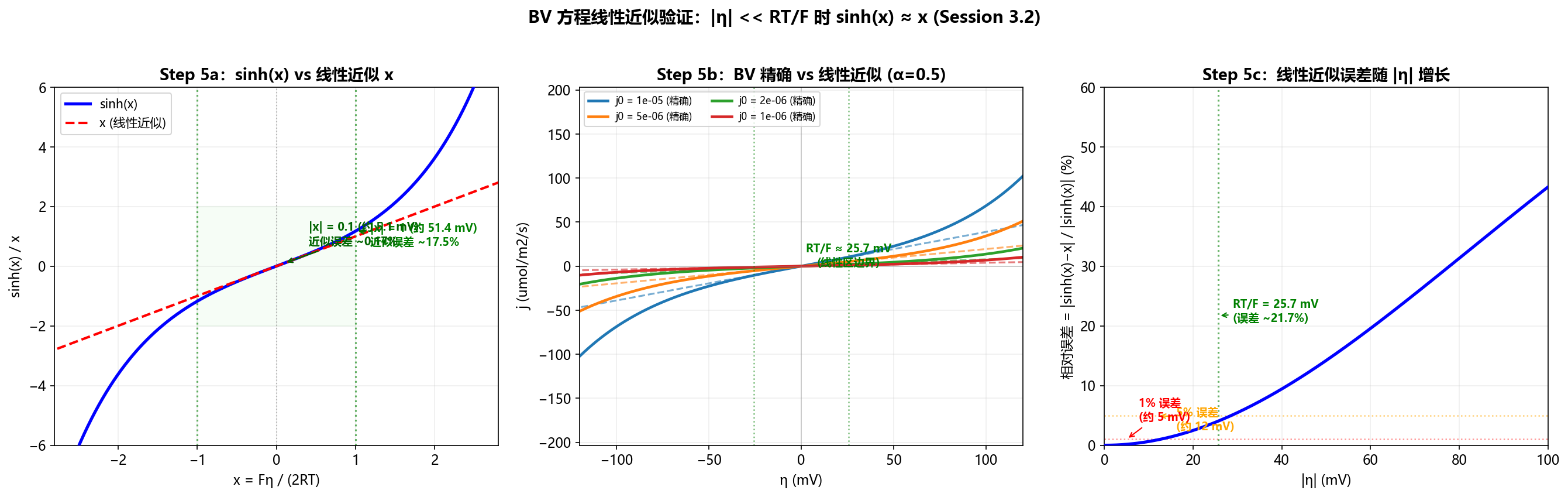
When |x| ≪ 1: sinh(x) ≈ x.
Substituting: j ≈ 2j₀·Fη/(2RT) = j₀·Fη/(RT), inverting:
$$\eta \approx \frac{RT}{F} \cdot \frac{j}{j_0} \quad\quad (|\eta| \ll RT/F)$$
| |η| Range | Error | Applicable Scenario |
|——|——|——|
| < 5 mV | ~0.2% | Small current (below C/5) |
| < 25.7 mV (RT/F) | ~21.7% | Medium current |
| > 50 mV | > 55% | ❌ Must use arcsinh |
Physical meaning: η = R_ct·j, where R_ct = RT/(F·j₀) is the charge transfer resistance — at small current, BV reduces to Ohm’s law.
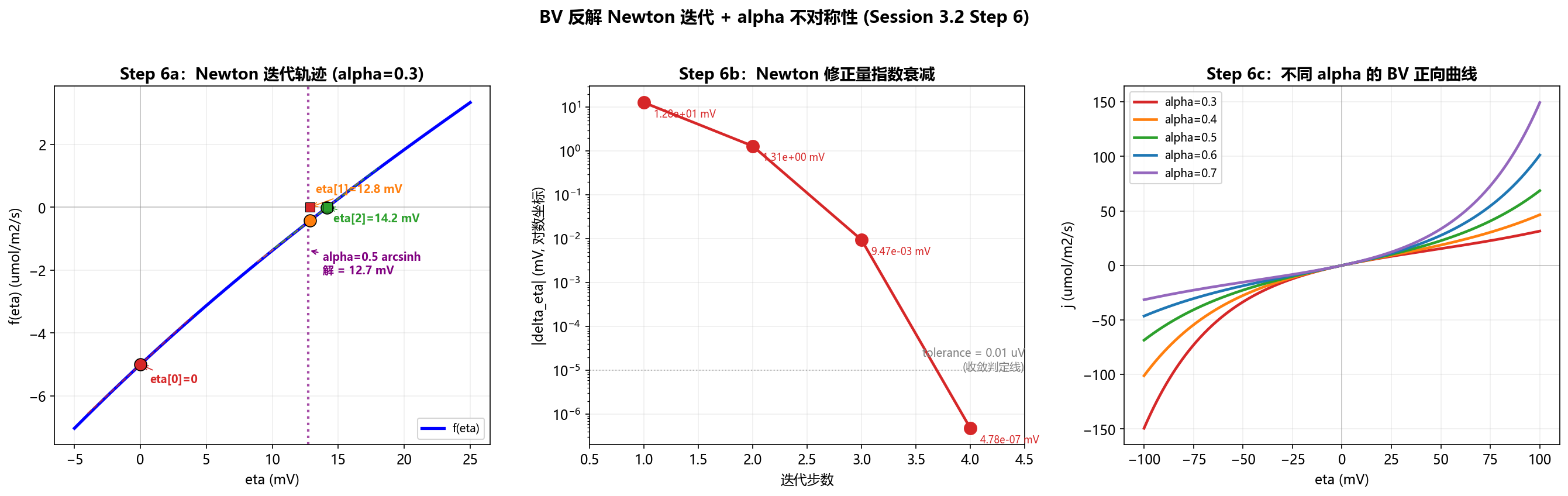
3.2.5 Why α≠0.5 Cannot Use arcsinh?
At α≠0.5, the two exponentials are asymmetric:
| α=0.5 | α=0.3 | |
|---|---|---|
| Exp 1 | exp(0.5A) | exp(0.3A) |
| Exp 2 | exp(−0.5A) | exp(−0.7A) |
| Symmetric? | Yes → sinh | No → no analytic solution |
3.2.6 Newton Iteration
Define the residual function:
$$f(\eta) = j_0 \cdot \left[ e^{\alpha F\eta/RT} - e^{-(1-\alpha)F\eta/RT} \right] - j$$
Newton formula:
$$\eta_{\text{new}} = \eta_{\text{old}} - \frac{f(\eta_{\text{old}})}{f’(\eta_{\text{old}})}$$
Geometric meaning: Draw tangent at current point → tangent’s x-axis intersection = next guess → repeat.
Convergence speed: Quadratic convergence — significant digits double each step. Starting from η=0, converges to nanovolt precision within 3 steps.
Algorithm logic (model.py lines 238–253):
1 | Algorithm: newton_bv_inversion(j, j₀, α, T) |
Session 3.3: Code Implementation — Independent Implementation + Visualization + Verification
3.3.1 Core Formulas (α=0.5)
1 | j₀ = k · c_e^0.5 · c_s_surf^0.5 · (c_max − c_s_surf)^0.5 |
3.3.2 Defensive Programming
| Issue | Solution |
|---|---|
| c_s_surf = 0 or c_s_max → j₀ = 0 → division by zero | np.clip(c_s_surf, 1e-12, c_s_max − 1e-12) |
| j/(2j₀) too large → arcsinh overflow | np.clip(j/(2*j₀), -1e10, 1e10) |
3.3.3 Independent Implementation: bv_my.py
1 | Function: bv_overpotential(j, k, c_e, c_s_surf, c_s_max, alpha, T) |
3.3.4 Verification Result
1 | my_bv: −2.630587 mV |
3.3.5 Generated Visualizations
| Figure | Content |
|---|---|
| linear_approximation.png | sinh(x) vs x comparison · j-η linear approximation · error growth |
| newton_bv_iteration.png | Newton iteration trajectory · correction decay · α asymmetry |
| bv_overpotential.png | η→j (different SOC) · j→η (arcsinh) · j₀ vs SOC |
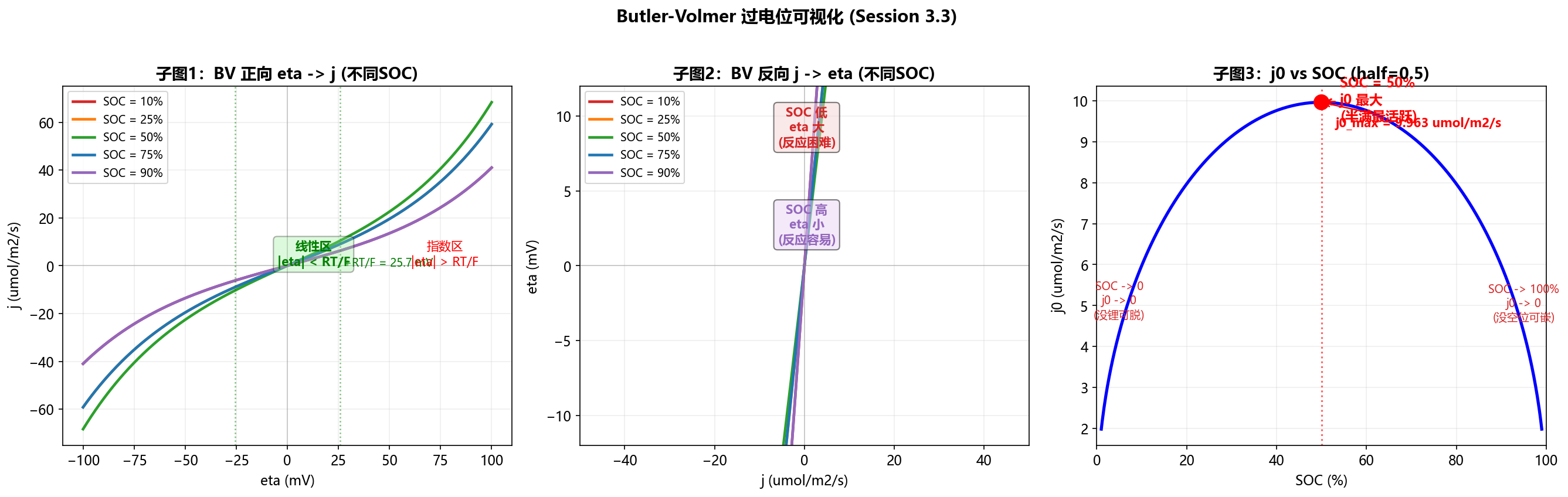
3.3.6 Interpreting the Three Subplots of bv_overpotential.png
Subplot 1: BV Forward η→j
| Observation | Meaning |
|---|---|
| Green shaded region ( | η |
| Outside green region | Exponential region, curve rises steeply |
| SOC=90% (purple) is flattest | j₀ is small → reaction is difficult |
| SOC=50% (green) is steepest | j₀ is maximum → reaction is easiest |
Subplot 2: BV Inverse j→η
| Observation | Meaning |
|---|---|
| SOC=90% (purple) at bottom | For given j, η is smallest → least reaction resistance |
| SOC=10% (red) at top | For given j, η is largest → most reaction resistance |
Subplot 3: j₀ vs SOC
| Observation | Meaning |
|---|---|
| “∩” shape curve | Classic shape of √x·√(1−x) |
| Maximum at SOC=50% | Equal lithium and vacancies, bidirectional flow is smoothest |
| Approaches 0 at both ends | SOC→0 (nothing to deintercalate) or SOC→100% (no vacancies to accept) |
File Index
| File | Purpose | Status |
|---|---|---|
session_03_background.md |
Session entry file | ✅ |
learning_notes_03_kinetics.md |
These notes | ✅ |
bv_my.py |
Independent BV implementation | ✅ 0 nV difference vs model.py |
visualize_linear_approximation.py |
Linear approximation visualization script | ✅ |
visualize_newton_bv.py |
Newton iteration visualization script | ✅ |
visualize_bv_overpotential.py |
BV three-subplot visualization script | ✅ |
linear_approximation.png |
sinh vs x + error growth | ✅ |
newton_bv_iteration.png |
Newton trajectory + asymmetry | ✅ |
bv_overpotential.png |
η→j + j→η + j₀ vs SOC | ✅ |
../../spm/model.py |
BV function source (butler_volmer_overpotential) | Reference |
../../spm/parameters.py |
Battery parameters | Reference |
Connection to Adjacent Chapters
1 | ┌──────────────┐ c_s_surf ┌──────────────┐ eta ┌──────────────┐ |
Preview Questions (Before Entering Chapter 4)
- Is OCV + η equal to the battery voltage? Are there other “deductions”?
- How are the four SPM equations (OCV, BV, diffusion, voltage coupling) chained together in model.py’s
step()? - If you had to write a
step()function from scratch, what inputs do you need? What does it output?
- Understand the physical meaning of overpotential
- Master the BV forward equation and j₀ dependence
- Hand-derive the α=0.5 arcsinh inversion
- Understand the small-η linear approximation and its range of validity
- Understand the Newton iteration solution approach
- Independently implement bv_overpotential() function
- Plot η-j curves and j₀ dependence graphs
- Compare independent implementation vs model.py (0 nV difference)
End of Notes · Next: Full SPM Implementation & Voltage Coupling